
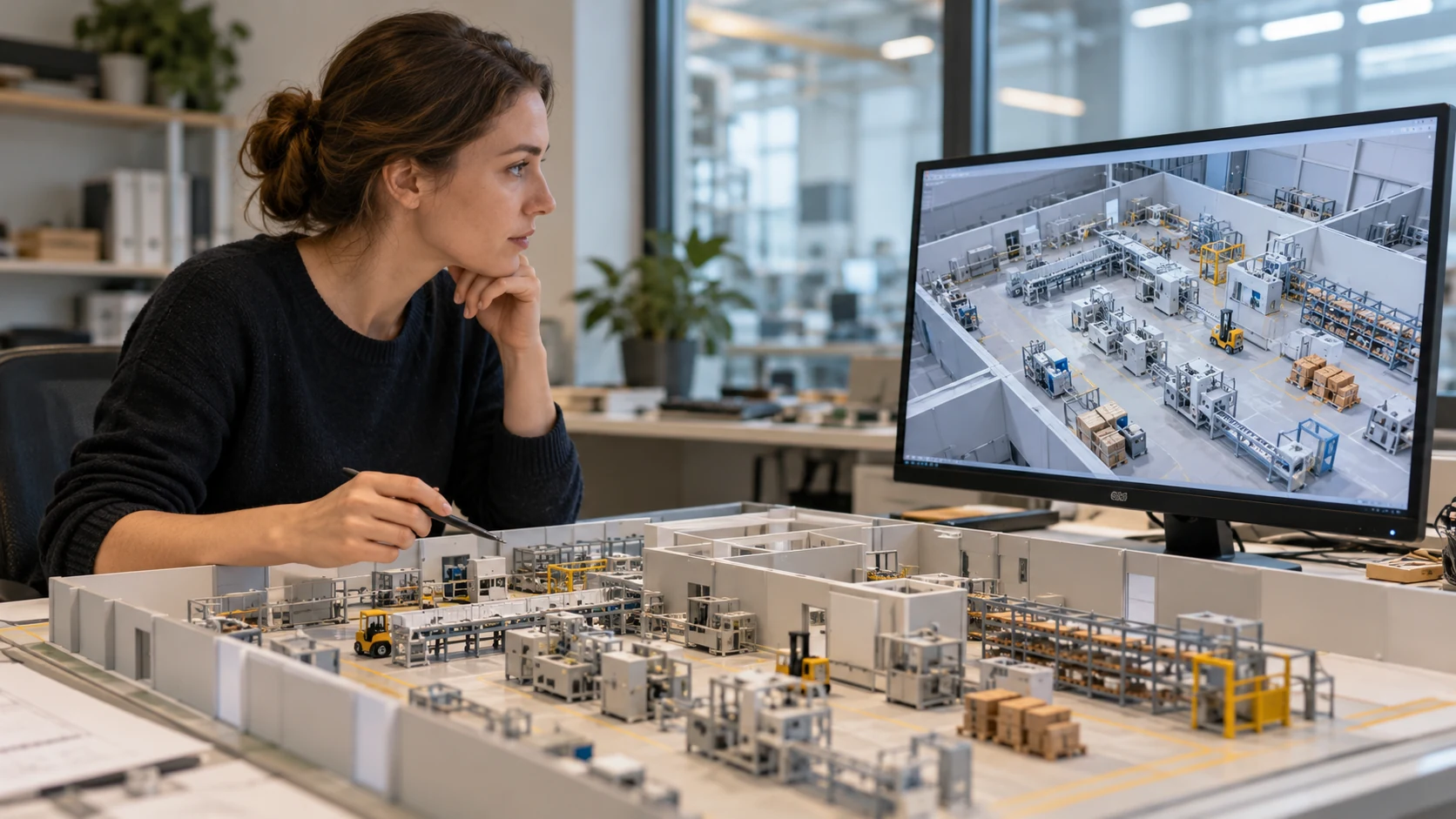
A detailed virtual factory can look impressive on a screen. The harder question comes after the demonstration: what will the production team do differently because this model exists?
Perhaps the business needs to compare two line layouts. Perhaps it wants to test a production schedule before committing people and equipment. Those are useful starting points because they connect the model to a decision with an owner and a consequence.
Start With the Decision, Then Define the Model
NIST describes manufacturing digital twins as synchronised virtual models that can help represent, diagnose, predict and improve operations. Its work also highlights the difficulty of building trustworthy models, particularly where standards, data and validation are involved. NIST: Digital Twins for Advanced Manufacturing
That does not mean every project needs a model of an entire factory. Our suggested buying approach is to define one decision first, then ask what the model must represent to support it.
For a hypothetical workshop comparing production sequences, the relevant details might include processing times, setup periods and equipment availability. An elaborate visual representation of an unrelated storage area may add little to that particular decision.
Ask What the Model Leaves Out
Every model has a boundary. Ask the supplier to explain it in language the operations team can challenge.
Does the model assume materials always arrive on time? Does it include the delay between a machine stopping and a technician becoming available? Are product changeovers represented by one average, or do different transitions have different demands?
These questions are not an argument against modelling. They help establish when the model is useful and when its answer needs additional judgement. Put important assumptions in the project documentation rather than leaving them inside a presentation.
Test It Against Work You Already Understand
A NIST paper on digital-twin credibility identifies verification, validation and uncertainty assessment as important throughout a model's life. In practical terms, a buyer needs evidence that the model behaves appropriately for its intended use. NIST: Credibility Consideration for Digital Twins in Manufacturing
One useful acceptance exercise is to select a past production period with reliable records. Ask the supplier to reproduce the relevant conditions and compare the model's output with what happened. Agree in advance which differences matter and who can accept them.
Then change one assumption and discuss the result with an experienced operator. If the output is surprising, can the team trace the reason? A recommendation that cannot be explained is difficult to use responsibly.
Plan for the Factory to Change
A model can become less useful if nobody updates it after equipment, products or working practices change. Assign responsibility for these updates and include that work in the budget.
Ask how the system handles missing or delayed data. A stale input should be visible to the person making a decision. Also clarify who owns the model files and whether useful data can be exported if the supplier relationship ends.
For an initial pilot, keep recommendations separate from automatic control. Give the production team room to compare the model with its current method before considering a wider operational role.
Write an Acceptance Question You Can Answer
“Does the digital twin work?” is too vague. A better question is: “Can this model help our team compare these two scheduling options, using the agreed inputs, within the agreed level of uncertainty?”
That question gives procurement, engineering and operations a common basis for review. It also makes a modest project easier to defend: a limited model that improves an important decision can be more valuable than a visually rich system whose purpose remains unclear.